
Most companies think strategy means beating competitors. They add features. They lower prices. They benchmark constantly. And slowly, they become indistinguishable from everyone else.
Blue Ocean Strategy by W. Chan Kim and Renée Mauborgne challenges this default thinking. Instead of competing harder, companies should create new value that makes competition irrelevant.
This book is particularly valuable for:
- Product leaders stuck in feature wars or roadmap debates.
- Executives facing saturated markets and slowing growth.
- Strategy teams trying to differentiate beyond pricing or features.
- Scaleups that feel trapped copying incumbents.
- Teams doing discovery work and searching for real differentiation.
Overall summary
The central argument of Blue Ocean Strategy is simple: companies achieve breakthrough growth by creating new market space, not by outperforming competitors.
The authors describe two types of markets: red oceans and blue oceans.
Red oceans are existing markets where industry boundaries are defined and accepted, competition is intense, and firms fight to capture a share of limited demand. As markets become crowded, products commoditize, margins shrink, and companies rely on incremental improvements or benchmarking rivals. Strategy in red oceans typically assumes a trade-off between differentiation and cost, reinforcing competition rather than escaping it.
Blue oceans, in contrast, represent new or redefined market space where demand is created rather than contested. Here, companies expand industry boundaries, unlock new customers, and generate strong growth with minimal competition. They achieve this through value innovation, simultaneously increasing buyer value and reducing costs by eliminating and rethinking the factors an industry competes on. Thereby breaking the traditional value-cost trade-off.
The book’s deeper claim is that markets are not fixed structures but malleable constructs shaped by strategic choices. Growth is not constrained by industry conditions but by managerial assumptions.
How companies create blue oceans
The book introduces a set of analytical tools and frameworks that make the creation of new market space systematic rather than accidental. These tools help organizations challenge industry assumptions, reconstruct market boundaries, and design offerings that deliver a leap in customer value.
Strategy Canvas
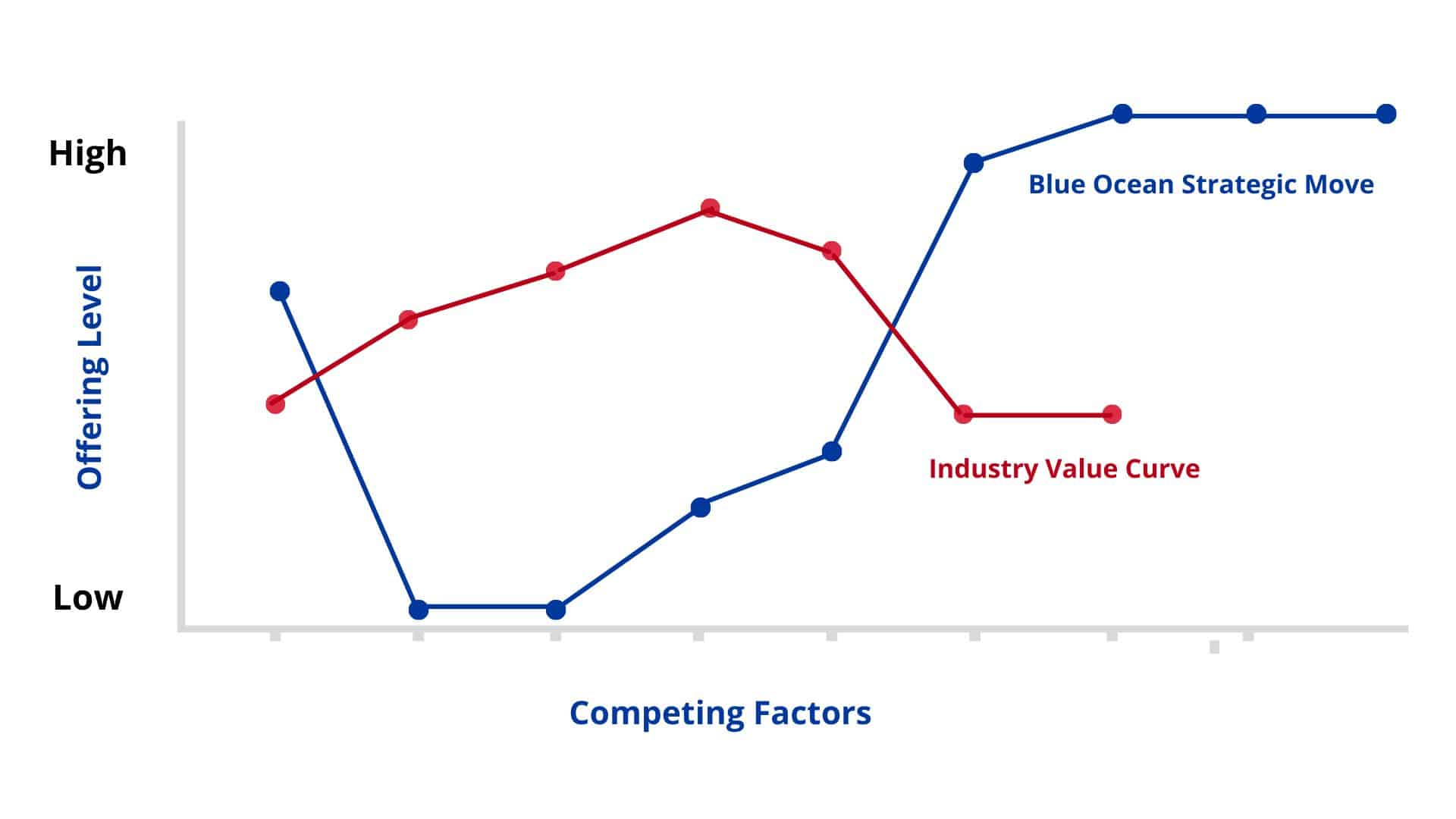
The strategy canvas visualizes how competitors invest across the factors customers value. It exposes how most companies converge on the same dimensions (a sign of red ocean thinking) and highlights opportunities to diverge by eliminating, raising, or creating value factors
Parallel value curves signal red ocean competition, while distinct curves indicate potential blue ocean strategies.
Source: www.blueoceanstrategy.com
Four actions framework
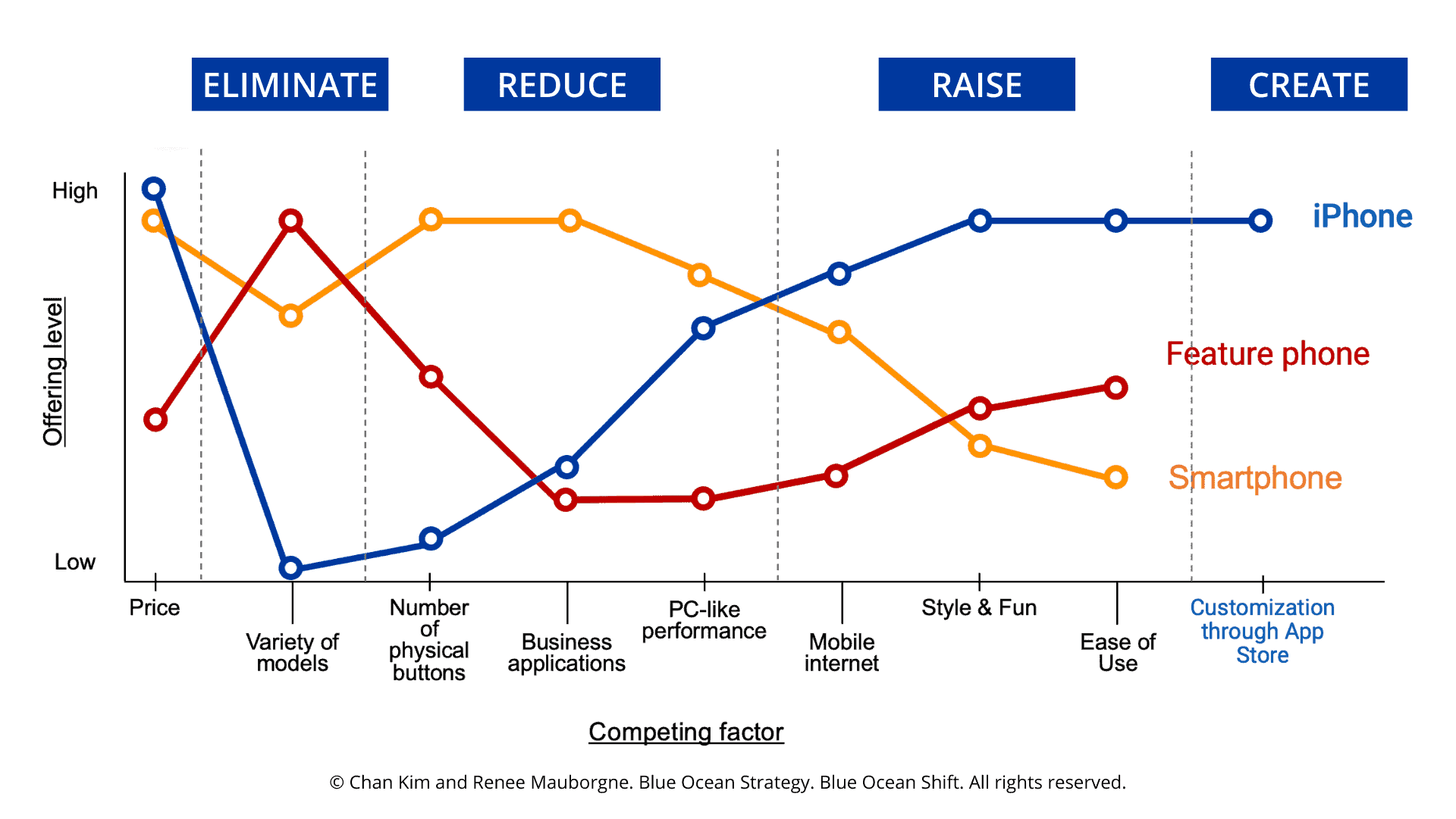
The four actions framework forces companies to challenge industry orthodoxy and redesign their value proposition.
- What should we eliminate that the industry takes for granted?
- What should we reduce below industry standards?
- What should we raise above industry standards?
- What should we create that the industry has never offered?
The goal is not incremental improvement but structural change in value.
Source: www.blueoceanstrategy.com
Non customer focus
One of the book’s key ideas is that the biggest growth opportunities come from non customers, not existing customers. Most companies obsess over serving current users better, which leads to segmentation, niche optimization, and incremental improvements. Blue ocean creators do the opposite: they look at why people avoid the industry altogether.
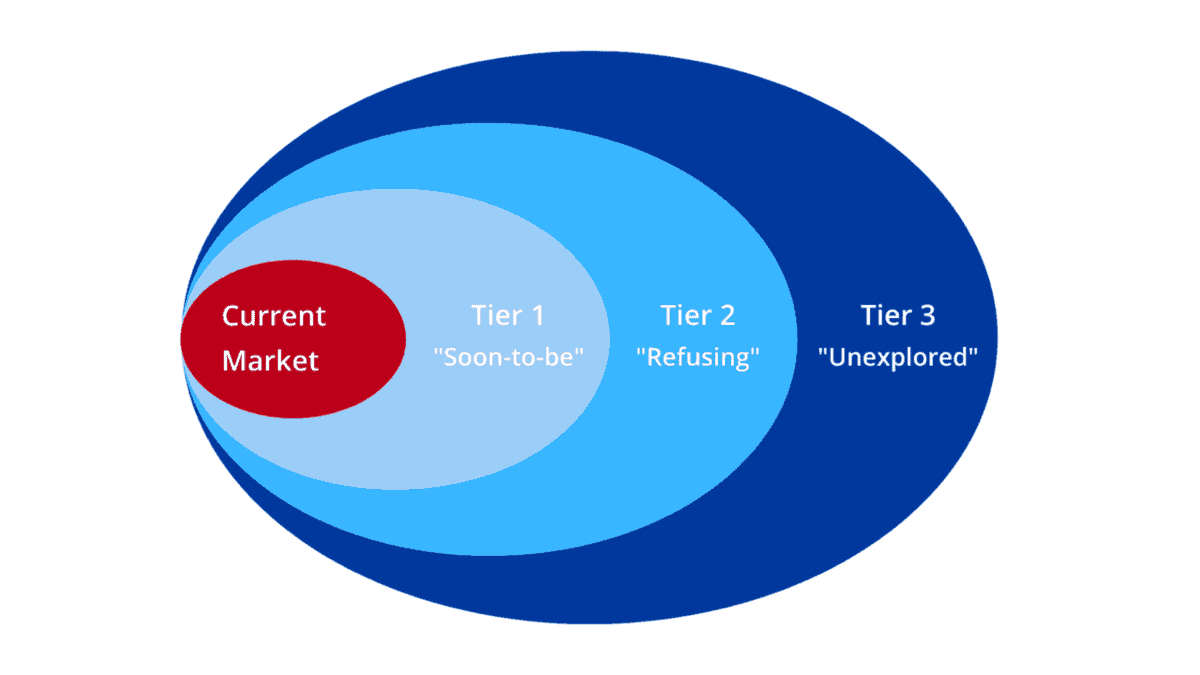
The authors describe three tiers of non customers:
- Soon-to-be non customers: people who minimally use the industry but are ready to leave (frustrated, overserved, or dissatisfied).
- Refusing non customers: people who consciously reject the industry’s offerings.
- Unexplored non customers: people whose needs have never been targeted or considered relevant.
Source: www.blueoceanstrategy.com
Instead of focusing on differences between customers, companies search for shared frustrations and common barriers across these groups. By removing complexity, reducing cost, or redefining the offering, they unlock large pools of latent demand.
The core insight is that markets grow by converting noncustomers into customers.
Buyer utility map
The buyer utility map helps identify hidden friction across the entire customer experience and reveals where companies can unlock new value beyond the product itself.
It maps six stages of the buyer experience:
- purchase,
- delivery,
- use,
- supplements,
- maintenance
- disposal
against six utility levers:
- customer productivity,
- simplicity,
- convenience,
- risk reduction,
- fun and image
- environmental impact.
By systematically exploring this matrix, teams can uncover overlooked pain points and new value opportunities across the full journey. It pushes organizations to move beyond feature improvements and rethink the entire customer experience to create meaningful differentiation.

Source: www.blueoceanstrategy.com
Though the tools are undoubtedly useful, the book’s deeper impact is the mindset shift: strategy should prioritize creating exceptional customer value over beating competitors. It reframes markets as expandable rather than fixed and treats innovation as a systematic process rather than a gamble.
This perspective changes how teams approach product discovery, differentiation, and growth, shifting focus from competing within existing rules to redefining them.
dualoop POV
The strongest part of Blue Ocean Strategy is how it reframes competition itself. It forces teams to ask uncomfortable but important questions:
- Why do we compete on these dimensions?
- What assumptions are we blindly following?
- Are customers actually asking for what we build?
The Strategy Canvas alone can transform product conversations. It exposes how often teams debate features while offering nearly identical value to competitors.
The book also connects naturally to modern product work:
- discovery-led development
- customer-centric thinking
- value-driven prioritization
- experimentation
In that sense, it feels surprisingly aligned with how strong product teams already operate.
What we didn’t love
The book often makes market creation sound easier than it is.
- Examples are mostly large enterprises (Cirque du Soleil, Ford, Samsung).
- Execution challenges are underexplored
- Resource constraints for smaller companies are barely addressed.
In practice, creating a “blue ocean” is messy, risky, and highly uncertain. Many teams fail because they jump to solutions before understanding customer value.
Why it matters for product teams today
Despite its limitations, the book is extremely relevant because most product organizations still operate in “red ocean mode”:
- benchmarking competitors
- shipping incremental features
- optimizing existing demand
Blue Ocean thinking pushes teams toward problem discovery and value creation, which aligns closely with dualoop’s product execution philosophy.
The most powerful idea in the book is: stop benchmarking competitors, start redesigning customer value.
In dualoop’s experience, most teams can’t create blue oceans because they begin with competitor/market analysis instead of customer problems. So we adapted this idea into a practical diagnostic tool.
The value differentiation diagnostic
Use this during discovery or strategy work to assess whether your team is competing or creating new markets.
Step 1 — Map your current value
List the top factors customers choose between (price, speed, features, convenience, service, etc.).
Step 2 — Compare with competitors
Ask:
- Would a customer see meaningful differences?
- Are we mostly similar?
- Where are we over-investing?
If differentiation isn’t obvious, you’re in a red ocean.
Step 3 — Challenge assumptions
Ask:
- What should we eliminate?
- What should we reduce?
- What should we raise?
- What should we create?
Push for bold changes, not feature tweaks.
Step 4 — Validate with discovery work
Use the dualoop product execution flow to validate your assumptions and discover new value.
- Problem framing → deeply understand the problem and identify real unmet needs
- Solution discovery → explore and test new value propositions
- Market impact → launch, measure, and validate real customer value
- Retire → stop or evolve solutions as markets change
Blue ocean thinking only works when grounded in real customer insight. New market space is discovered through disciplined problem understanding, experimentation, and continuous learning.
A real blue ocean story
A real blue ocean story from the article comes from Jijo and his team at Esko, who inherited a small, underperforming product in a crowded market where competing on price or features wasn’t leading anywhere.
Instead of fighting incumbents, Jijo and his team stepped back and reframed the problem, focusing on an overlooked customer need that others had ignored. By positioning their product as the first meaningful solution in this space, they created new demand and avoided direct competition.
They reinforced this advantage through continuous improvements and an early shift from on-premise software to SaaS, unlocking scalability and long-term growth. Rather than playing the existing game better, they changed the game entirely turning a weak position into a strong growth engine.
You can read more about it here.
One thing to remember
If you remember one idea from Blue Ocean Strategy, make it this:
“The only way to beat the competition is to stop trying to beat the competition.”
Growth doesn’t come from competing harder. It comes from creating new value and solving problems others overlook.
Stop watching competitors. Start rethinking customer value. That’s where real differentiation, and real growth, happens.

