
Product work means making decisions with incomplete information, often under time pressure and with real consequences for customers and the business. Yet many teams still treat uncertainty as something to manage later, once delivery has started.
Risk and assumption mapping exists to do the opposite. It helps teams surface what they do not know and decide deliberately what to learn first. When done well, it prevents teams from investing in the wrong solution or uncovering critical flaws far too late.
This guide is written for product managers actively working on an initiative and is designed to be run tomorrow with your product trio. The focus is practical, not theoretical. Risk management is not a phase or a one-off workshop, it is a continuous discipline that starts as soon as an initiative is framed.
Why risk and assumption mapping matter in product discovery
Most failed initiatives do not fail because teams lacked effort or competence, they fail because teams acted on assumptions that were never tested.
We see the same patterns in organisations repeatedly: teams assume customers will adopt a solution because it makes sense internally.
- They assume usability will not be an issue because the interface looks clean.
- They assume feasibility because the architecture feels flexible.
- They assume viability because someone did a back-of-the-envelope calculation months ago.
But none of these are facts: all of them are hypotheses that deserve scrutiny before the team commits further.
Risk and assumption mapping forces teams to separate what they know from what they believe. It also helps them agree on what would hurt the most if they were wrong. That alignment is critical, especially when discovery time is limited.
Within the Product Execution Flow, assumption mapping is early, during problem framing, and is revisited throughout discovery. It informs what you test, in what order, and why.
The role of the product trio in managing risk
Risk is shared, but not evenly distributed. Each member of the product trio is accountable for different risk dimensions.
The product manager primarily owns value, viability, and ethical risk. Whether the team is solving a real problem, whether customers will choose this solution, whether it makes sense for the business, and whether it aligns with values and constraints.
The product designer primarily owns usability risk. Whether users can understand, navigate, and effectively use the solution in their real context.
The tech lead primarily owns feasibility risk. Whether the team can build and operate this solution with acceptable trade-offs in performance and long-term cost.
Risk and assumption mapping works best when all three perspectives are present. Running it alone as a PM turns it into a prioritisation exercise, but running it together turns it into a learning strategy.
Step 1. Surface your assumptions across five risk categories
💡 Separate what you know from what you believe.
Start by listing assumptions, not risks. An assumption is a belief you are acting on without sufficient evidence. If this belief turns out to be false, your initiative will be affected.
A practical way to do this is to scan the initiative through five lenses.
Valuable
“My intended customer will choose to use the proposed solution.”
Examples of assumptions.
- Customers experience this problem frequently enough to care
- This problem is important compared to their other priorities
- The proposed approach addresses the root problem, not a symptom
Usable
“My intended customer can use the proposed solution.”
Examples of assumptions.
- Users understand the terminology and mental model
- The solution fits into existing workflows
- Edge cases do not break the experience
Feasible
“My team can build the proposed solution.”
Examples of assumptions.
- Required data is available and reliable
- Performance constraints are manageable
- Technical dependencies will not block progress
Viable
“The proposed solution works for the business.”
Examples of assumptions.
- The solution supports strategic objectives
- Costs are justified by expected impact
- Revenue or efficiency assumptions are realistic
Ethical
“The solution aligns with the company's values and external constraints.”
Examples of assumptions.
- Data usage complies with regulations and expectations
- Incentives do not push harmful behaviour
- The solution does not create unacceptable long-term risks
At this stage, quantity matters more than precision. Capture assumptions as short, testable statements and avoid vague language. If you cannot imagine how you would test an assumption, rewrite it until you can.
Step 2. Plot assumptions on a 2×2 matrix
Once assumptions are listed, the next step is to decide which ones deserve attention first.
Assumption mapping uses two dimensions:
- Uncertainty. How confident are we that this assumption is valid?
- Impact. If this assumption is wrong, how damaging would it be to the initiative?
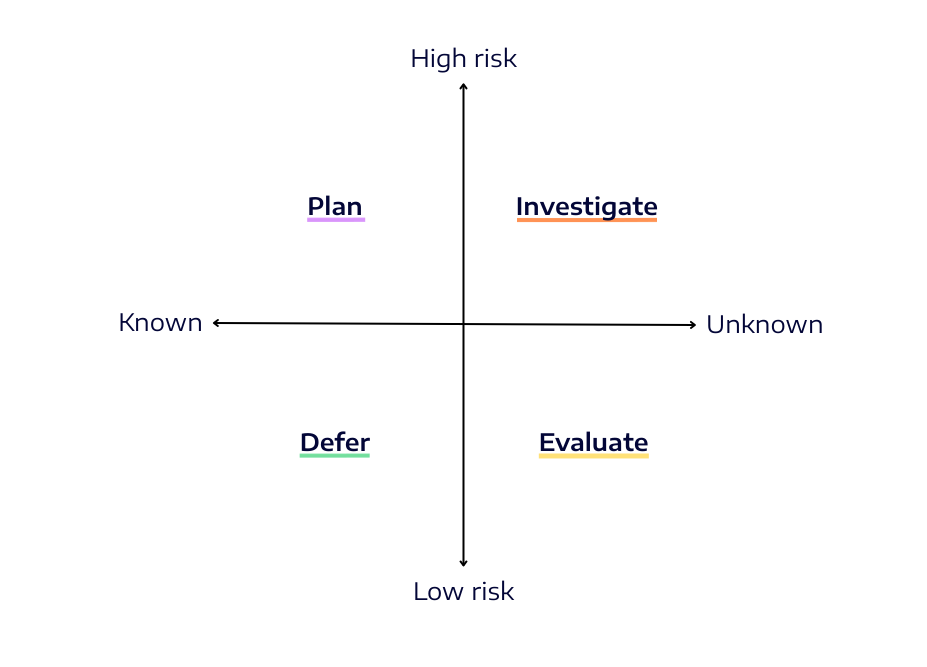
Draw a simple matrix. Uncertainty on the horizontal axis, from known to unknown. Impact on the vertical axis, from low risk to high risk.
Then place each assumption on the map.
Step 3. Decide what to test now, later, or never
💡 Turn the map into learning decisions.
Each quadrant implies a different action.
Investigate: Learn before building.
These are assumptions that are both highly uncertain and highly impactful. If they are wrong, the initiative is seriously compromised.
Investigating means prioritising learning before committing further. These assumptions should directly shape your discovery plan. They deserve immediate attention from the trio, explicit experiments, and clear success criteria. Building without addressing these is a conscious gamble.
Most discovery effort should be spent here.
Plan: Move forward with guardrails.
These assumptions have a high impact but relatively low uncertainty. Teams usually have evidence, experience, or precedent to support them, but the consequences of being wrong remain significant.
Planning means acknowledging the risk and preparing a mitigation strategy rather than testing it urgently. This could involve contingency plans, staged rollouts, monitoring metrics, or validation later in discovery. These assumptions should not block progress, but they should never be invisible.
Evaluate later: Park it consciously.
These assumptions are uncertain, but their impact is limited. If they turn out to be wrong, the initiative can usually adapt without significant damage.
Evaluate later means capturing them without letting them compete for attention with critical risks. Revisit them when the initiative evolves, new information appears, or effort becomes cheaper.
Defer: Do not spend discovery time here.
These assumptions are both low-impact and low-uncertainty. They are often operational details or edge cases.
Defer means tracking them lightly, if at all. Teams often waste energy trying to eliminate these risks instead of tackling the ones that actually matter.
Step 4. Convert assumptions into risk statements
💡 Turn beliefs into accountable risk statements.
An assumption becomes a risk when you acknowledge the possibility of being wrong. For each high-priority assumption, rewrite it as a risk statement.
For example:
Assumption. Customers will adopt the new workflow without additional support.
Risk. Customers may resist the new workflow, leading to low adoption and limited impact.
This shift matters because it changes the conversation from optimism to responsibility, and it prepares the ground for deciding how to reduce that risk.
At this point, it helps to explicitly organise risks into the five risk categories. This ensures ownership is clear across the trio.
Step 5. Choose what to test first based on risk type
Discovery time is finite, and you cannot test everything.
Use the assumption map to decide what to test next. Start with assumptions that are both highly uncertain and highly impactful. These are the assumptions that could invalidate the initiative if proven wrong.
Testing does not mean building a feature. It means running the cheapest possible experiment that meaningfully reduces uncertainty.
- Value risks often require customer interviews, problem exploration, or demand tests
- Usability risks often require prototypes and usability testing
- Feasibility risks often require technical spikes or architectural reviews
- Viability risks often require modelling, stakeholder alignment, or market analysis
- Ethical risks often require early involvement of legal, compliance, or leadership
The level of fidelity should match the risk you are testing. Use the least amount of effort required to get a reliable signal.
Step 6. Integrate into the Product Execution Flow
Risk and assumption mapping is not a one-time exercise that happens during a kickoff and then disappears.
Within the Product Execution Flow, it should be created during problem framing, when the initiative is still fluid. It should be challenged and refined during the trio kick-off. It should actively inform what discovery work is prioritised next. And it should be updated continuously as new insights, data, and constraints emerge.
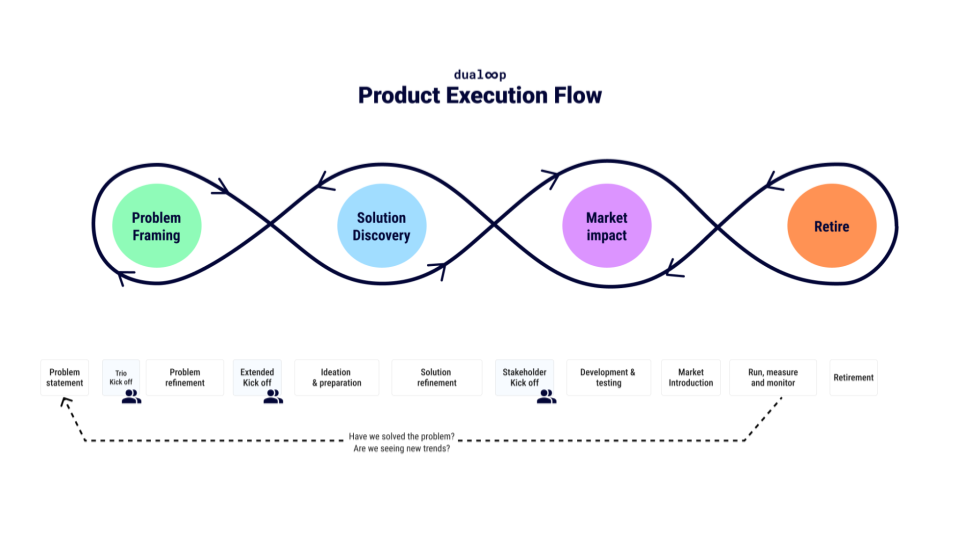
The Product Initiative Document is the natural home for this. It allows assumptions, risks, mitigation strategies, and learnings to evolve instead of being frozen in a slide deck.
Teams that integrate risk and assumption mapping into their execution flow consistently make better decisions under pressure. Trade-offs become explicit, learning becomes intentional, and stakeholder conversations become clearer because uncertainty is acknowledged rather than hidden.
Example. How one assumption moves across the map
To make the mapping tangible, here is how a single assumption evolved for a B2B SaaS team working on self-serve onboarding.
Context. The team was building a new self-serve onboarding flow intended to reduce sales dependency for smaller customers. One assumption appeared: "New customers will complete onboarding without human assistance."
Here is how that assumption moved across the map as evidence accumulated.
Investigate
At the start, the team had little direct evidence. If customers did not complete onboarding alone, the entire self-serve strategy collapsed.
This placed the assumption firmly in investigate. The trio prioritised customer interviews and a low-fidelity onboarding prototype to reduce value and usability risk before committing to delivery.
Plan
After early tests, most users completed onboarding, but a minority still struggled at specific steps. The impact remained high, but uncertainty was reduced.
The assumption moved into plan. The team defined mitigation strategies, designing fallback support, monitoring completion metrics, and preparing human intervention for edge cases.
Evaluate later
As the product matured, data showed that incomplete onboarding affected only a small segment with limited business impact.
The assumption became evaluate later. It was still monitored, but no longer competed with higher-risk assumptions in discovery.
Defer
Eventually, onboarding completion was stable and predictable. Remaining issues were operational rather than strategic.
The assumption was deferred. It stayed documented, but no longer drove discovery effort.
If you run this tomorrow
If you are doing risk and assumption mapping for the first time, keep it simple. The goal is progress, not perfection.
A practical way to run the session.
- Timebox it to 60 to 90 minutes
- Bring your product trio only
- Use sticky notes or a shared board, not a polished deck
Rules of thumb that keep it runnable.
- If you argue whether something is an assumption, it probably is
- If you cannot explain how you would test it, rewrite it
- If everything ends up in investigate, you are being too vague
- If nothing ends up in investigate, you are being overconfident
What good looks like at the end.
- A short list of high-risk assumptions you will test next
- Clear ownership across the trio
- Fewer opinions, more learning planned
If you leave with a perfect map but no next step, the exercise failed.
Making it stick in your team
The real value of risk and assumption mapping is not the session itself, it is the habit it creates.
Teams that do this well become more explicit about uncertainty and prioritise learning over output. They build trust with stakeholders by showing they deliberately manage risk rather than avoid it.
If your organisation is not used to this, you do not need a significant shift to start. Pick one active initiative, run the exercise with your trio, and use it to decide what you learn next, then check how it is perceived by your stakeholders.
This alone can change the trajectory of your product work.
When mapping reveals risks you cannot ignore
Risk and assumption mapping shows you where uncertainty sits, but identifying the risks is only half the work. Testing them is what protects your investment.
If your mapping exercise surfaced assumptions in the investigate quadrant, you are facing a choice:
- You can build anyway and hope you are right
- Or you can spend 4-12 weeks validating those assumptions before committing significant budget.
We run structured discovery tracks that turn high-risk assumptions into evidence-based decisions. Through targeted customer interviews, prototype testing, and synthesis, we help leadership teams answer the questions that matter before approving spend.
Recent examples: we helped a European bank validate their crypto value proposition in four weeks, and prevented an HR SaaS company from wasting 12 months building an AI product customers did not want.
If your team has identified critical assumptions but lacks the capacity or method to test them properly, let's talk about a discovery track.

