
Every senior PM we work with eventually says the same thing: "I don't have time to think." The strategy memo gets pushed to Sunday night. The discovery synthesis happens in 20-minute fragments between meetings. The roadmap that needed three hours of clear thought gets two, then one, then a back-of-the-envelope.
What breaks the week is its shape, not the amount of work in it. Standups, refinement, reviews, retros, stakeholder syncs, 1:1s, three different Slack channels that all believe they need an immediate response. The PM week is engineered to fragment attention, and yet the most valuable parts of the role (defining problems, making strategic bets, synthesising discovery, writing the document that aligns everyone) all require the opposite.

Cal Newport's Deep Work has been the standard text on this problem for the better part of a decade. The argument is simple: deep focus is becoming harder to find at the very moment it is becoming more valuable. Newport calls this the deep work hypothesis, and we think it lands harder for product managers than for almost any other role. But Newport's prescriptions assume a calendar autonomy that PMs do not have. No PM can disappear to a cabin for a week when the role exists to be the integration point for a trio and its stakeholders.
So what does a deep work practice look like inside a calendar you only partly control?
This playbook turns Newport's framework into a routine that holds up against sprint cadence, the demands of the trio, and everything else that has a claim on your week.
A note on scope. What follows covers personal deep work, the solo blocks where you write the strategy memo or synthesise the interviews. Collaborative focus inside the trio is a separate practice that runs alongside it. We start here because this is the mode that fails first.
Why deep work is the PM's actual edge
Before getting into the routine, let’s look at four reasons why deep work is such a critical part of effective product management.
- Strategy requires depth. Roadmap thinking, opportunity mapping, the document that turns a bet into a decision: none of this happens in 25-minute gaps. If you don't carve out the time, you get tactical output and call it strategic work.
- Insight comes from judgment. AI can transcribe your five user interviews, cluster the themes, and surface plausible patterns in minutes. But the work that turns themes into product bets (judging which pattern is load-bearing, spotting where the AI synthesis is plausible but wrong, deciding what the team should actually do with it) still requires sustained, undistracted contact with the material. The PMs producing sharp insights are the ones who can tell when an AI-generated synthesis misses the story.
- Strategic work compounds. The PM who consistently produces a few strong strategic pieces each quarter, a memo that stops a doomed feature, a problem definition that changes the team’s direction, or a roadmap argument that secures budget, gradually becomes someone leaders trust on important decisions. By contrast, a PM who spends most of their time reacting to immediate requests may deliver plenty of valuable work, but have less opportunity to shape the decisions that determine the product’s direction.
- Craftsmanship comes with focus. Newport makes a strong argument we rarely see addressed in PM literature: meaningful work comes from craft, and craft requires depth. Many of the PMs we coach have lost touch with the part of the job they originally fell in love with: the thinking part. Deep work is how you get it back.
There's an equation Newport offers that we find useful: High-quality output = time spent × intensity of focus. Both terms matter. Two hours of fragmented attention is not equivalent to one hour of focus.
Why deep work is rare anyway
We know all of this. So why don't we do it?
Three forces. First, the technology environment is hostile by design. Slack, email, and notification systems are engineered for engagement, not for your output. Second, PM culture rewards visible responsiveness over invisible thinking. The PM who replies to every channel within five minutes looks productive. The PM appears absent during a 90-minute deep work block. Third, the calendar fills passively. Nobody else protects your time, so by default, it gets consumed by other people's agendas.
The combination produces a shallow-work mindset where PMs measure themselves by activity rather than by output. We've seen PMs at otherwise excellent organisations operate this way for years. Willpower alone won't fix it, what's needed is structure.
Step 1: Choose your deep work philosophy
Newport identifies four philosophies for organising deep work, but they're not equally suited to product management, so we'll assess which ones actually hold up.
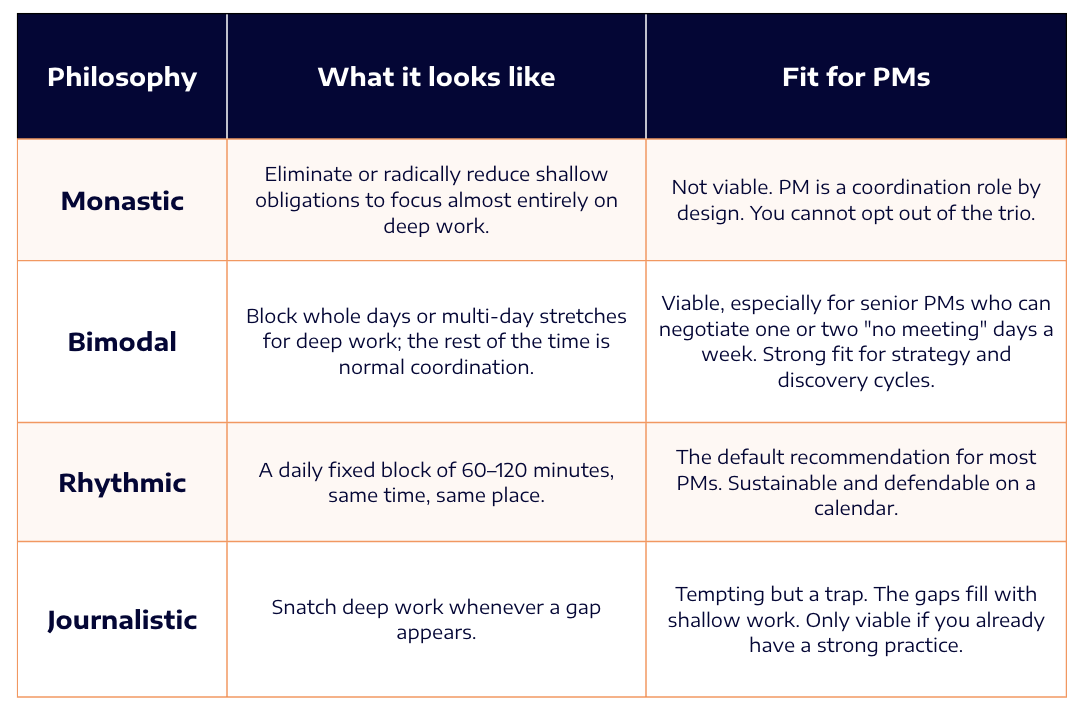
Pick one. The choice is about calendar architecture.
→ If your week is broken into many short windows with strict meeting cadence (most PMs in delivery-heavy quarters), rhythmic is the answer.
→ If you can negotiate one or two "no meeting" days (PMs in discovery cycles, or with a manager who understands the trade), bimodal will take you further.
→ If you don't yet have the calendar authority to defend full days (most associate and mid-level PMs don't), default to rhythmic and revisit bimodal once you do. Trying to run Bimodal without the political cover almost always collapses.
Don't try to do both at once. Run one philosophy for at least four weeks before reassessing.
Step 2: Build the routine that supports it
Once you've chosen, the practice has to be specified. Five elements. We've simplified the original Newport list because PMs need fewer levers, more sharply tuned.
- Where. A single, consistent location. A specific desk. A specific café. The point is that your brain learns to enter focus mode when you arrive there. If you work from home, this means not your sofa.
- When. Match the block to your actual cognitive peak. Most people overestimate their afternoon capacity. The PMs we coach who succeed at this almost universally end up running their deep work block in the morning, typically 8:00–9:30 or 9:00–10:30, before standup contaminates the day. If your standup is at 9, push it to 10.
- What. Decide the deliverable the night before (not the topic). "Work on the discovery synthesis" is a topic. "Produce a one-page narrative that names the three opportunity bets" is a deliverable. If you wait until the session starts to figure out what you're producing, you lose the first 20 minutes just deciding.
- How long. Start with 60-minute sessions and build up to 90 over time; anything beyond 120 is rare and earned. Newport's research shows that focus capacity is finite per day. Most people max out at three to four hours of true deep work, and PMs realistically have one to two.
- Coming back. A short ritual at the end and a short ritual at the start. End with a one-line note of where you stopped (so the next session has a launchpad). Start with a fixed cue: the same coffee, the same playlist, the same first move. This isn't about magical thinking; the ritual simply removes the cognitive cost of deciding to begin.
A note on difficulty: most people need two or three cycles before this clicks. The first week feels artificial. The second week, something gets interrupted. By the fourth week, if you've defended the block, you'll start to feel the difference in your output. If you haven't seen the difference by week six, it's almost always because you skipped Step 5.
Step 3: Run it like a product
This is the step most deep work advice misses, and it's where we see the biggest gap between PMs who try the practice and PMs who keep it. The trick is to treat your deep work the way you treat your roadmap: commit, measure, retro.
- Commit. Each deep work session has a deliverable, declared in advance. Write it down where someone else (your manager, your trio) can see it. The simplest version: put it in the title or description of the calendar block itself, so the deliverable is the first thing anyone sees when they look at your week. The accountability changes the practice.
- Measure. Track two things. The lead measure is the number of minutes of uninterrupted focus: the time during which you did not check anything. You can measure this with a phone timer. The lag measure is whether the deliverable was shipped. Both matter. Lag-only measurement makes you defensive; lead-only measurement turns the practice into a ritual.
- Retro. Once a week, look back. Which sessions worked? Which got cannibalised? What killed Tuesday? Was it the surprise stakeholder ping, the delivery escalation, or your own decision to "just check Slack first"? Treat the retro the way you'd treat a sprint retro: name the obstacle, design a small change for next week, ship it.
This step connects deep work to your operating rhythm, not just your personal habits. Treated as a productivity hack, the practice tends to fade out within a quarter. Built into how you actually ship your job, it sticks.
The Newport reference here, for those interested, is the Four Disciplines of Execution framework: identify the wildly important goal, define a lead measure, build a scoreboard, and create an accountability cadence. This is a framework we use with PM teams routinely, and it maps directly onto deep work practice.
Step 4: Sharpen the practice
By this stage the routine should be running on its own, and the temptation is to leave it alone. Three refinements are worth the extra effort. They all work on the intensity side of Newport's equation rather than the time side, which matters because the calendar is not going to give you another hour.
- Make focus the default. Most PMs treat deep work as something they have to squeeze into an otherwise reactive day. Reverse that. Set specific windows for shallow work (email, Slack, status updates) and protect the rest of the day for focused work. For example, two 30-minute communication windows at 11:30 and 16:30, with Slack closed in between. The trade-off is slightly slower replies; the payoff is reclaiming a meaningful part of the day for strategy and thinking.
- Work against a deadline. A 90-minute block can easily expand into three hours when there’s no clear endpoint. A time constraint forces you to make decisions and keep moving. Define both the outcome and the time limit: “By 10:30, the discovery one-pager is in Notion, even if it’s only v0.7.” A rough artefact you can react to is far more useful than a perfect version that exists only in your head.
- Make space for productive meditation. The 5-minute walk between meetings is where some of the best PM thinking happens, but only if you are deliberate about it. Pick a specific problem before you stand up (something like "what's the actual mechanism behind the activation drop?") and resist the urge to phone-check. Most PMs treat these moments as recovery time; we treat them as a second-tier deep work mode that produces some of the sharpest framings of the week.
Step 5: Defend the boundary
This is where most PMs lose the habit, so it deserves its own step.
There are four main threats to deep work: notifications, Slack, ad-hoc availability, and shallow-work creep.
The solutions are simple, but they require consistency:
- Remove notifications. Put your phone in another room during deep-work blocks (not face down on your desk). Turn off Slack notifications on both desktop and mobile.
- Create clear availability windows. Set a daily period when you're explicitly available for questions and quick decisions. Outside that window, make it clear that responses may be slower.
- Protect the calendar. Once a quarter, review recurring meetings. Every meeting should justify its place; if it no longer does, remove it.
- Make the output visible. The easiest way to defend focused time is to show what it produces. If you're regularly shipping decisions, documents and strategic work, it's much easier to justify being less immediately available.
The uncomfortable part is that people may initially see this as being less responsive. That's normal. The answer isn't to abandon the boundary; it's to demonstrate that you're trading responsiveness for meaningful output.
There is one person who deserves particular attention: your manager. For many people, managers are a major source of interruptions: the 9:15 Slack message, the same-day request, the surprise Tuesday meeting. It’s normal and managers don’t do it to distract on purpose. They have to deal with their own challenges and reality.
Don't try to work around this. Bring it up in your next 1:1. Position deep work as the way you'll deliver the strategic output they've been asking for, rather than as a request to be left alone. Most managers will understand the trade-off and help protect the time. If they don't, that's useful information too: it tells you something about what the organisation actually prioritises.
The first month will be the hardest. People are adjusting to a new way of working. After a few months, the team learns your rhythm, and the boundary starts to feel less like a rule you have to enforce and more like the normal way you work.
If you run this tomorrow
Four concrete steps to take today:
- Pick a philosophy. Rhythmic if your week is meeting-heavy; bimodal if you can negotiate a no-meeting day.
- Block a 90-minute slot in tomorrow's calendar before someone else does. Title it specifically ("Discovery synthesis: name the three bets", not "deep work"), and put the deliverable in the description.
- Write that deliverable down as a single sentence somewhere visible to your future self: in Notion, on paper, or simply in the calendar event itself.
- Turn off Slack notifications on your phone, every channel, until that block is done.
Then run one cycle. Retro it on Friday. Adjust.
Key takeaways
- Deep work is harder for PMs because of role design, not because PMs are weaker than other knowledge workers. The fix is structural.
- Of Newport's four philosophies, only Rhythmic and Bimodal are realistic for PMs. Pick one and run it for at least four weeks.
- Specify the deliverable, not the topic. The first 20 minutes of an unstructured session will be wasted.
- Treat deep work the way you treat the roadmap: commit, measure, retro. Without that, it's a habit, and habits decay.
- The biggest threat to the practice is not your discipline. It is the rest of the organisation, sometimes including your manager. Step 5 is non-negotiable.
- Most people need two or three cycles before this clicks. Plan for a four-week build, not a one-week experiment.
A closing note
If your team is producing more meetings than decisions, the problem is rarely the people. It's the operating rhythm. Deep work is one lever; how the team measures progress, allocates time, and protects thinking are the others. We help product organisations redesign that operating rhythm so that the work that matters actually has the time it needs. If that resonates, get in touch.

