
Product managers are comfortable making risky decisions every day: they evaluate feature bets, prioritise roadmaps under uncertainty, and navigate ambiguity with structured thinking. Yet when it comes to their own careers, many abandon this discipline entirely.
Lindsey Nguyen, a product leader who has navigated roles at Apple, McKinsey, Techstars-backed startup, and multiple 0-to-1 ventures shares her approach to career management. Her framework is pragmatic, structured, and strategic, applying the same rigour to career moves that product managers bring to their work.
What follows is the framework Lindsey shared, designed for product managers and product leaders who want more agency in their career paths.
The Eight Principles:
- Match your focus to your timeline
- Build your five-lever scorecard
- Build a business case and financial safety net
- Treat interviews as two-way discovery
- Demonstrate next-level skills before you need them
- Leave when you've achieved your goals, not when you're burned out
- Run personal retros
- Maintain genuine relationships
Eight principles for resilient career management
1. Match your focus to your timeline
Career thinking works across three different time frames, and the biggest mistake is optimising for the wrong one.
If you need to make a decision in three weeks, worrying about your five-year plan just burns energy. If you're stable in a role right now, ignoring what comes next means you'll miss the chance to shape it.
2. Build your five-lever scorecard
Every career opportunity can be evaluated against five core dimensions. Not all of them need to score highly for every role, but you should know which ones matter most to you right now.
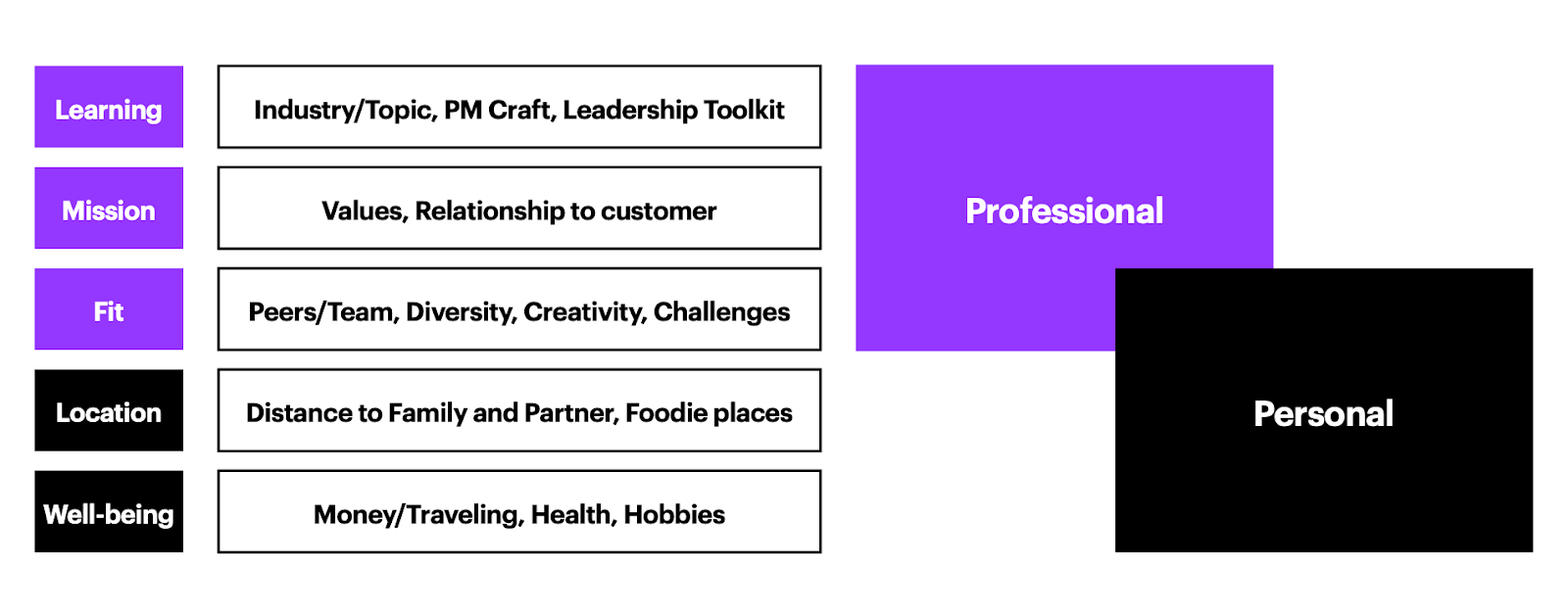
3. Build a business case and financial safety net
You should be modelling the financial side of major career decisions the same way you'd model a product bet. Calculate your personal runway: how long you can sustain yourself if the move doesn't work out.
Six months of savings is the baseline. With that buffer, you can leave a toxic role without panicking about money, take a lower salary for a role with better learning potential, or negotiate from a stronger position because you're not desperate.
"I know I will give myself six months in role or six months after that. Like, I can quit today and spend six months and try to find my next role and figure something out." - Lindsey Nguyen
When you're looking at a new role, model the total compensation realistically. If there's equity involved, base your assumptions on realistic valuations, not the best-case scenario the founder is painting. Compare that to what you're giving up. If the learning and mission don't make up for the financial difference, either negotiate harder or walk away.
You should also set clear success criteria when you join a role. What do you actually want to achieve in the first six months, the first year, the first 18 months? This gives you a way to measure whether the role is working, rather than just drifting along and hoping it gets better.
4. Treat Interviews as two-way discovery and negotiate transparently
Interviews should be mutual discovery sessions, not performances where you're trying to impress someone into picking you.
The questions you ask should reveal how the team actually operates, not just what they say in the job description. Ask things like: "What's it like to work with this person when they're really stressed?" or "How long are you committed to this project?" or "What's the plan for the team if scope increases?" Ask about recent disagreements and how they got resolved. This tells you whether the team has a real culture of constructive challenge or whether people just nod along.
When you have competing offers or specific needs, be transparent about them. Lindsey shared her competing offer when she was deciding whether to co-found SwiftComply. She told her potential co-founder exactly what salary she was being offered elsewhere and what equity structure she'd need to make it work.
"I gave him the offer that I had from the other business and we were able to come to a discussion about what the things that mean success for him was and what it is that means success for me." - Lindsey Nguyen
If you have non-negotiables (flexibility for health reasons, remote work, specific location requirements) state them early. If the organisation can't work with them, better to know that before you join than three months in.
5. Demonstrate next-level skills before you need them
When you're already in a role and thinking about what comes next, your job is to start demonstrating the capabilities required for that next level.
Be explicit with your manager or leadership about what you're working to improve. Ask peers and team members for feedback on your progress. This builds up a body of evidence. When an opportunity does come up, you're not asking someone to bet on your potential, you're showing them the skillset is already there.
"In the next year or so, I'm really looking at: how can I start demonstrating the next role, the skill sets that I need, how I'm currently performing against that already by looking at a few roles ahead of time." - Lindsey Nguyen
The mid-term timeframe is about using the stability of your current role to invest in yourself, so you're ready when the next opportunity appears.
6. Leave when you've achieved your goals, not when you're burned out
Most people stay in roles too long. They wait until they're completely burned out, deeply frustrated, or so misaligned that everyone can see it, and by then, leaving feels like failure rather than progression.
A better signal is simpler: leave when you've achieved what you set out to do.
When you join a role, set clear objectives. What do you want to learn? What do you want to build or ship? When you've ticked those things off, the question becomes: is there something else here that still excites me, or have I learned what I came to learn?
"If you've ticked those things off, then the question for me is, is there more that you can do that will keep you excited? Is there anything else laterally or other projects that you would be excited to lead?" - Lindsey Nguyen
Check in regularly on whether the role still aligns with your learning goals. Does the mission still feel meaningful to you? Has the team dynamic changed in ways that drain your energy instead of recharging it? If the answers are no, start exploring what's next. Don't wait until you're completely spent.
7. Run personal retros
If you never stop to reflect, you won't build a career you're actually happy with. You'll just react to whatever opportunity shows up next.
Run personal retros the same way you'd run a team retro. What's working? What's not? What are your non-negotiables? Be honest with yourself about what's motivating you right now. Is it money? Is it achievement? Is it security? Is it meaning? Is it recognition?
These motivators shift as your career evolves and your life changes. What drove you five years ago might not be what drives you now, and being honest about what matters most right now helps you make better decisions about where to go next.
8. Maintain genuine relationships
The other critical piece is maintaining genuine relationships with people you respect. Almost every senior role gets filled through warm introductions, not through job boards or cold applications. The people who move into great opportunities are usually the ones who've stayed connected, helped others, and built a reputation that travels with them.
"I've opened many more doors with my McKinsey peers, my peers from Techstars that say, Hey Lindsey, we think you could help in this area. Or, I've also recommended folks into a space to be able to help move the organization along because I'm not the right fit." - Lindsey Nguyen
This isn't networking in the transactional sense. It's staying in touch with people whose work you admire, sharing what you're learning, helping when you can, and being someone others want to work with again. That effort compounds over time. When you do need an introduction or advice, those relationships respond.
Applying product discipline to your career
The core idea here is simple. Product managers already know how to evaluate risk, build business cases, and make decisions with incomplete information. Most of them just don't apply that same discipline to their own careers.
Build a business case for major moves. Model the financial implications. Talk to people in the organisation before you join. Set clear success criteria at the start, and check in regularly on whether you're progressing against them.
Continue Learning
Explore more on product leadership and career growth:
- Product Manager Assessment Framework - A structured approach to evaluating PM capability and identifying growth areas
- From BA to PM - Making the transition from business analyst to product manager
- How to Get Your Dream Product Management Job - Practical tactics for landing your next PM role
Build the skills that create career options:
- Product Management Guide: Unlocking Organisational Excellence - Core capabilities that accelerate PM careers
- Product Leadership: How Top Product Managers Launch Awesome Products - What separates good PMs from great ones
- The Ultimate Guide to Organizing Your Life as a Product Manager - Frameworks to manage your work and career effectively
Strengthen your organisation and team building skills:
Our Product Management Training covers strategy, discovery, delivery, and leadership. Built for product managers and leaders who want to operate at the next level.
Join the conversation:
We run regular webinars and Product Apéros with product leaders sharing practical frameworks. Check upcoming events or sign up for our newsletter to stay in the loop.

