
Most teams get roadmaps wrong
Every team has one, few use it well.
Most product teams struggle with roadmap planning. At dualoop, we’ve seen dozens of product teams treat roadmaps as a list of things to build. But a roadmap isn’t a list of features to build, it’s a strategic communication tool to align teams around impact and keep stakeholders confident.
In our product execution flow, the roadmap sits between strategy and execution. It translates product strategy (the “why”) into initiatives the organisation can act on (the “how”), without pretending to know exactly when everything will happen.
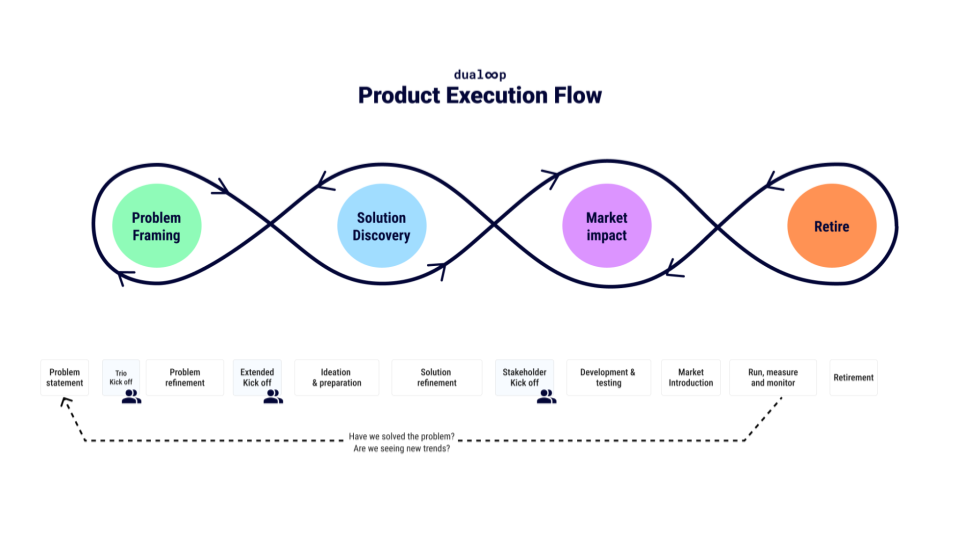
That balance between guidance and flexibility is what separates a roadmap that builds trust from one that breaks it.
What is an outcome-based roadmap?
An outcome-based roadmap is a product planning tool that organises work around measurable business outcomes rather than feature deliverables. Instead of listing 'what we'll build and when,' outcome-based roadmaps communicate 'what results we're driving and how we'll know we've succeeded.'
This approach maintains strategic flexibility while building stakeholder trust through transparent learning.
1. Effective roadmap planning starts with conversation
Traditional product roadmap planning treats roadmaps as one-way announcements. Product managers build them in isolation, present them to stakeholders, and hope for approval.
But before a roadmap becomes a visual artefact, it needs to emerge from a conversation about context, trust, and alignment.
A roadmap’s real value lies in the dialogue it creates before it’s published:
- What outcomes matter most for the business this year?
- How will we measure them?
- What risks and assumptions do we still need to validate?
- What is the sequence of learning we expect across “Now”, “Next”, and “Later”?
At dualoop, this is why we say: “don’t create your roadmap in your corner.”
The process of building it collaboratively, with your product trio, your key stakeholders, and leadership, is what generates alignment and trust. The document that emerges is simply the artifact of that trust.
2. Outcome-based roadmaps vs. output-based
The most mature roadmaps are not lists of deliverables, they’re structured around objectives and outcomes.
Outputs are the things you build: features, releases, integrations.
Outcomes are the changes that those outputs create: more retained users, faster onboarding, higher conversion, lower churn.
To build an outcome-based roadmap:
- Start from objectives. These should connect directly to your product or business OKRs.
- Example: “Reduce time to first value by 30% for new users.”
- Identify initiatives that could drive those outcomes.
- Example: “Simplify onboarding flow,” “Improve in-app guidance,” “Launch contextual trial mode.”
- Keep initiatives flexible. As discovery unfolds, you may pivot or reframe them. The outcome stays constant; the path to reach it evolves.
When you frame your roadmap this way, you’re not promising features, you’re committing to solving the right problems.
3. The Now–Next–Later roadmap framework
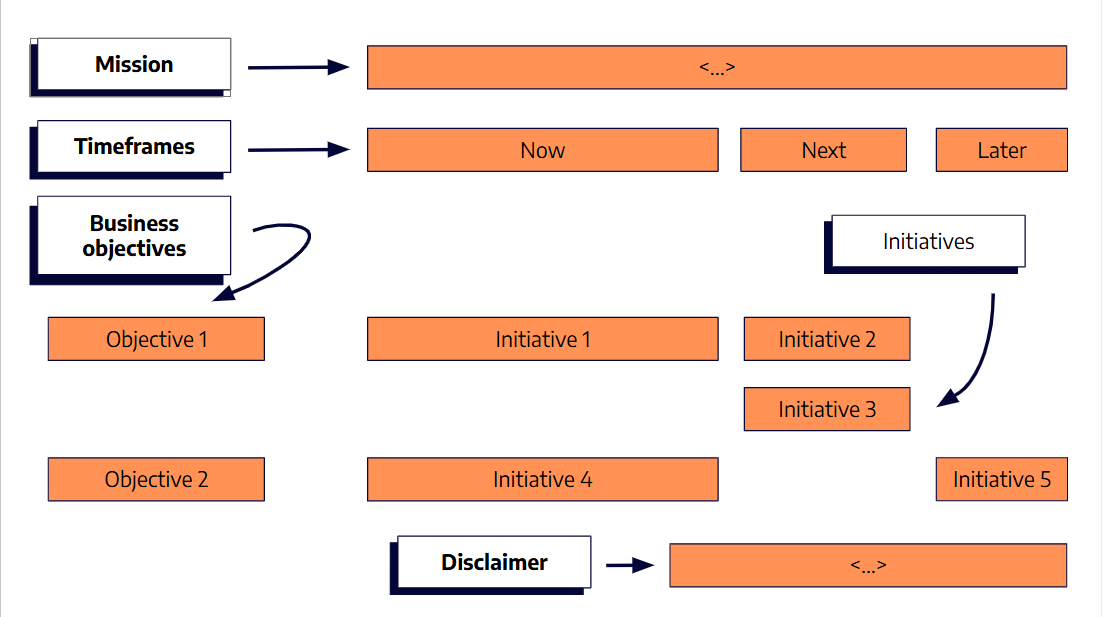
The Now–Next–Later roadmap framework is one of the simplest and most powerful approaches to outcome-based roadmap planning.
It replaces artificial deadlines with time horizons and makes your discovery progress visible without overpromising.
Here’s how we use it at dualoop:
Each section connects objectives (on the left) to initiatives (on the right):
Objective → Initiative(s)
Outcome we aim for → Possible ways to reach it
Example:
Why this format works
- It’s transparent. Everyone sees what’s active, planned, and exploratory.
- It invites discussion. The right-hand side (“Initiatives”) can evolve as learning grows.
- It reinforces discovery. “Next” and “Later” show intent without pretending to have solutions yet.
This corresponds to the natural evolution of an initiative from problem framing → solution discovery → solution delivery → market impact.
4. Product roadmap best practices: Guidance over guarantees
A roadmap should offer guidance, not guarantees.
Most PMs feel pressured to make promises because leadership, sales, and customers expect certainty. However, the irony is that the more false precision you add, the more trust you erode when plans inevitably change.
We use the term high-integrity commitments to describe the few promises you can safely make:
- Commit only when you have validated discovery data.
- Make the duration explicit (e.g., “Now = this quarter”).
- Review it regularly and communicate changes early.
This turns your roadmap into a trust-building mechanism, not a compliance tool.
As Marty Cagan wrote in Transformed, empowered product teams thrive on outcomes and trust, not control and output. A roadmap that constantly evolves based on validated learning signals maturity, not instability.
5. Internal vs external roadmaps
Not all roadmaps serve the same purpose.
Internal roadmap:
- Used by your team, stakeholders, and leadership.
- Focused on outcomes, learning progress, and assumptions.
- Updated frequently (monthly or quarterly).
External roadmap:
- Used for customers, partners, or the wider market.
- Simplified view of themes and problems being addressed.
- Communicated carefully to avoid perceived promises.
The best PMs are transparent without oversharing. They communicate intent (“we’re exploring better ways to X”) instead of committing to timelines they can’t control.
In dualoop’s coaching, we often tell PMs: “if your external roadmap is a mirror of your internal one, you’ve probably gone too far.”
6. Collaborative roadmap planning
The quality of your roadmap depends on how you build it.
At dualoop, we always insist on co-creation through the product trio: the product manager, the designer, and the tech lead. Together, they map the most critical outcomes, risks, and dependencies across five dimensions:
- Value risk — will customers care?
- Usability risk — can they use it?
- Feasibility risk — can we build it?
- Viability risk — is it sustainable for the business?
- Ethical risk — is it aligned with our values?
When you build a roadmap collaboratively, you avoid the classic “PM in a corner” trap. Stakeholders become co-owners of the direction instead of passive reviewers of your slides.
A roadmap review meeting should sound less like a pitch and more like a shared diagnosis.
7. Common pitfalls (and how to avoid them)
Even experienced PMs fall into these traps:
8. How often to update and share your roadmap
A good roadmap is a living artefact.
How often to update it:
- Monthly: for your trio and internal alignment.
- Quarterly: for company-wide or leadership review.
- Annually: to refresh horizons and validate strategic fit.
How often to share it:
- Internal: after every significant discovery learning or release.
- External: once or twice a year, only when direction is stable enough to communicate confidently.
The goal is to maintain guidance with flexibility. Every update should tell a story: what we learned, what changed, and why that’s good news.
9. Roadmaps as maturity signals
When we assess organisations through our dualoop snapshots, one of the clearest indicators of maturity is how they treat roadmaps:
Moving from the first to the third stage requires humility and repetition. You can’t force trust, you earn it through transparent communication and consistent follow-up.
A roadmap that evolves based on new insights isn’t a sign of volatility, it’s proof of learning.
10. Your checklist for building an impactful roadmap
Here’s a condensed, actionable checklist to build and maintain a roadmap that truly creates impact:
✅ Start from objectives, not features. Link every initiative to a measurable outcome.
✅ Use the Now–Next–Later framework. Communicate time horizons instead of deadlines.
✅ Co-create with your trio. Capture diverse perspectives early.
✅ Involve stakeholders early. Don’t surprise them with a finished roadmap.
✅ Keep themes high-level. Avoid turning your roadmap into a backlog.
✅ Differentiate internal vs external views. Tailor communication.
✅ Treat it as guidance. Make high-integrity commitments only when confident.
✅ Update it continuously. Reflect learning, not just progress.
✅ Anchor it in trust. A roadmap is a conversation, not a control system.
Conclusion: Clarity beats certainty
An impactful roadmap doesn’t show certainty, it shows clarity. It tells your organisation: we know where we’re going, we know why, and we’re learning fast.
When you build it through collaboration, align it to outcomes, and keep it alive through continuous discovery, your roadmap becomes more than a document, it becomes a shared compass. And that’s how product teams evolve from managing outputs to driving impact.

