
Most PMs learned the job by doing it. That's where the confidence comes from, but it's also where the blind spots are.
If you have been doing product management for a while, some of this will sound familiar:
- Your roadmap reflects what stakeholders asked for more than what the product strategy needs.
- Discovery is always on the agenda, but it rarely happens.
- You ship things and aren't sure whether they worked.
- Your team uses the same product vocabulary but each person means something different by it, so alignment conversations rarely produce alignment.
- You've read the books and you know the theory. The gap is that your environment doesn't give you room to use any of it.
"I knew what I was talking about and I wasn't talking nonsense. I could be confident in myself." Aditi Luykx, Senior PM, Politico Europe
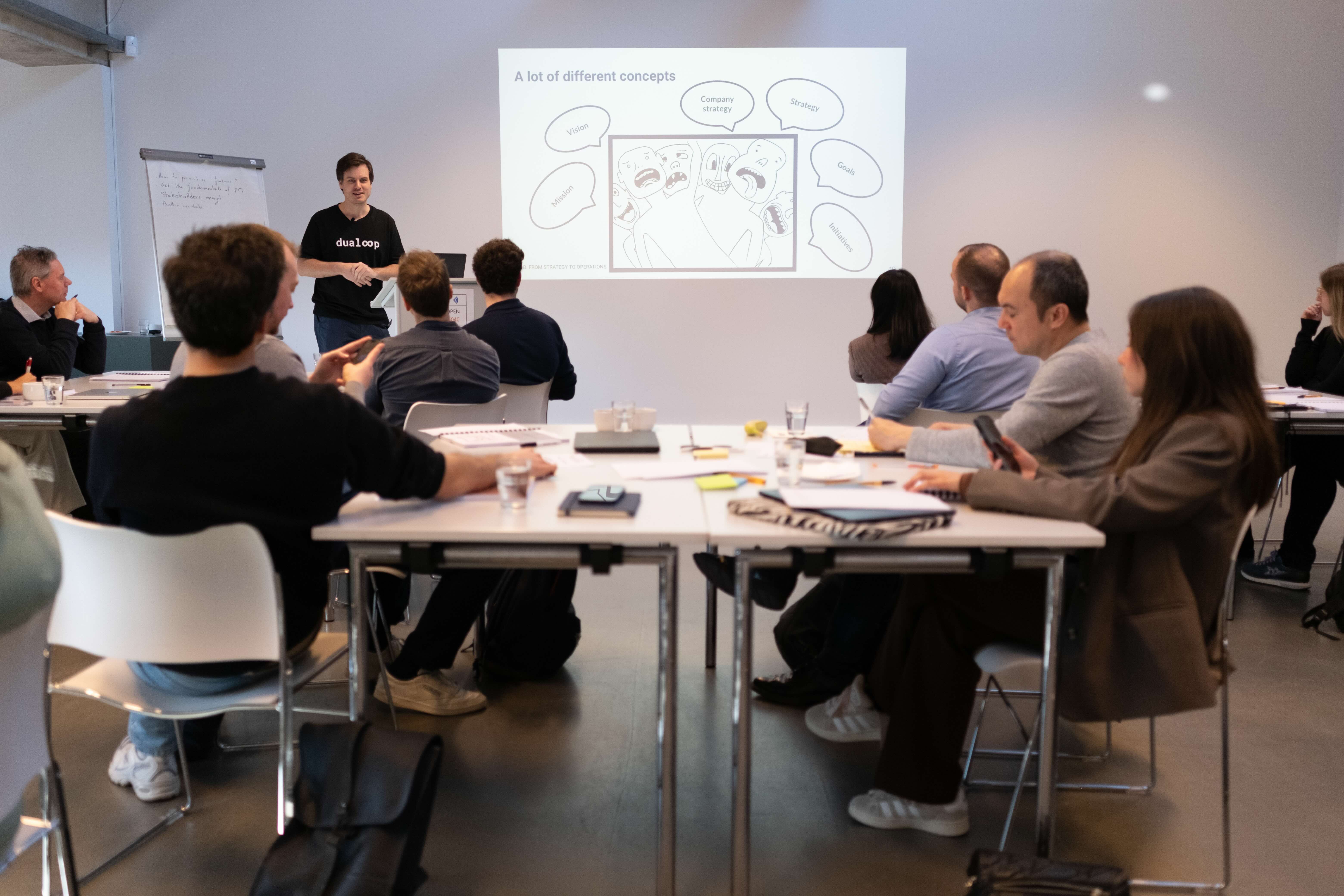
Six things you'll be able to do
Scan the list: where can you already do this confidently? Where can you not?
Strategy
Connect your roadmap to company strategy so stakeholders can see the logic. Use the product context model and the opportunity solution tree to map mission through to initiatives, and to stop building things that don't connect back to the company's direction.
Research
Write a problem statement that engineering can work from, without asking for clarification. A well-formed problem statement defines who is affected, what is happening, and what the impact is. Not a solution in disguise.
Discovery
Run a customer interview that surfaces what people need, rather than what they say they want. Learn to separate the symptom from the underlying problem. Leave the interview with insights, not feature requests.
Measurement
Choose KPIs before you build, not after, so you know whether what you shipped worked. Define what success looks like before the work starts. Know when to iterate, when to hold, and when to retire.
Go to market
Plan a launch so that adoption is part of the scope, not an afterthought for the marketing team. Use the STICK method to plan how the product reaches users and how it sticks. Understand what the PM owns at launch and what product marketing owns.
Stakeholders
Use a structured approach to align stakeholders who have conflicting expectations. Apply the communication approach from the training to negotiate, influence, and take the personal out of difficult conversations about roadmap and priorities.
"My team really saw a before and after. I dared to say no more often." Sam Boribon, PM, Nodalview
Your two days
The training follows a single case study from start to finish, so every method is applied in sequence rather than in isolation. By the end of day two, you can see how it all connects.
Day 1 - Strategy, context and discovery
From company goals to a validated problem worth solving
Product foundations
What a product is, how the lifecycle works, and what the PM role looks like alongside design and engineering. A shared starting point for everyone in the room.
From strategy to operations
The full product context from mission through to initiatives. You work through how to set objectives using OKRs and identify opportunities using the opportunity solution tree.
Problem framing and research
How to write a problem statement, plan qualitative and quantitative research, and run customer interviews that produce insights rather than feature requests.
Discovery in action
Ideation methods, story mapping, and iterative refinement. You generate ideas against a real problem statement and decide which paths are worth pursuing.
Day 2 - Delivery, go to market and leadership
From a solution to a shipped product you can prove is working
Solution delivery
Delivery approaches, prioritisation methods, and planning techniques that improve predictability. How to estimate without overpromising and keep the team aligned.
Market introduction
The STICK method for product launch. What makes a launch land, and why most releases go unnoticed. Where the PM's responsibility ends and product marketing's begins.
Measure, monitor and run
Choosing the right KPIs before you build, using data during the run phase, and deciding when to iterate, pivot, or retire.
Stakeholder management
The communication approach. How to align, negotiate with, and influence people who have different incentives from yours.
What makes this training different
✅ Your trainer is still doing the job
Mathieu works inside product organisations on active consulting mandates. The examples in the training come from recent client work, not a generic case library. When you bring your situation into the room, he can work with it.
✅ Exercises follow a single shared case from day one to day two
The training follows one case study from strategy through to launch. Every method is applied in sequence, so you leave with a connected way of working, not a collection of isolated techniques.
✅ Works at any experience level
"Whether you have 15 years of experience or none, there is something here to learn and apply." People earlier in their career build the foundation; more experienced PMs use it to put structure around what they already do intuitively. Both leave with something concrete.
Your trainer
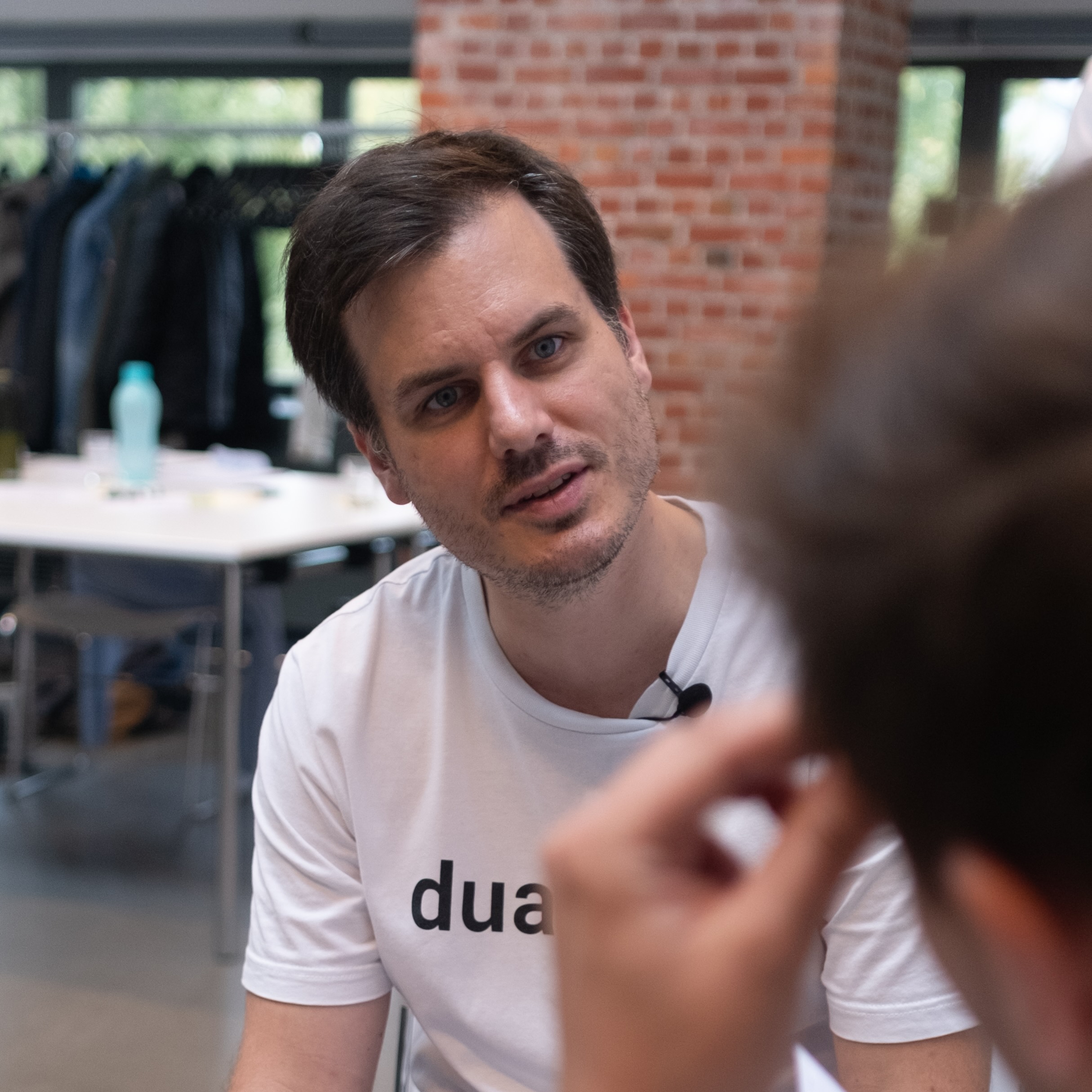
Mathieu Thys, manager @ dualoop
Mathieu spent several years in product roles at Twipe, Gambit, and Elia before joining dualoop as a consultant. He now spends most of his time inside product organisations, coaching teams, running diagnostics, and helping companies build product practices that last.
The training comes from that ongoing work. He runs the sessions in a way that responds to the room.
If you want to talk through your situation before registering, he's happy to have a quick call.
Talk to Mathieu >
What past participants say
⭐️⭐️⭐️⭐️⭐️ 9.3/10
Average satisfaction across all cohorts since 2022
"It helped me distinguish what belonged to theory versus what were just people's good ideas. I could depersonalise certain processes."
— Charlotte De Trez, Head of Products @ Aware

"It structured things. It's a toolbox that allows you to save time and not make certain mistakes from the start."
— Jean-Baptiste Mairy, Product Manager @ N-Side (came with the entire product team and the Managing Director)
"A no brainer for every product manager."
— Jago Winnen, Product Manager @ Vanden Broele
"The training helped align our team and provided practical tools we can use immediately."
— Olivier Delamotte, Head of Product @ Qualifio
"A great quality training, taught by real product experts, in a professional atmosphere."
— Eve André, Head of Product @ Keytrade Bank
Who is this for
Product managers and product owners
Whether you're six months in or six years in, this training gives you a complete picture of the role. Particularly useful if you came into product from a different function, or if your practice has gaps you can't quite name.
Heads of Product sending their team
The most common outcome when teams attend together is a shared vocabulary and a common starting point, which means fewer meetings start with a round of terminology negotiation. Several past buyers have sent four or more people and used the training as the foundation for a new way of working.
Ask about team rates and invoicing >
Product-adjacent roles
Business analysts, designers, and engineers who work closely with PMs. Past participants in these roles said it significantly improved how they work with their product counterparts.
Where this training is less suited: if you're a CPO or Head of Product looking for content on organisational design or OKR rollout at scale, that's a different conversation. Get in touch and we'll tell you whether this is the right next step. Contact us >
What's included
📚 Training playbook
A full digital playbook covering every chapter, with definitions, methods, and worked examples. In English. Most participants refer back to it for months after the training.
🗂️ Templates
Ready-to-use templates for problem statements, opportunity solution trees, OKRs, and stakeholder communication plans.
🎓 Digital certificate of completion
A digital certificate upon completion, ready to share on LinkedIn.
🍳 Breakfast, lunch, and a post-training drink
Both days include breakfast and lunch. On the evening of day two, there's a post-training drink for anyone who wants to keep the conversation going.
💬 Access to the dualoop Slack community
Ongoing access to a community of product professionals who've been through the same training.
📖 Book recommendations
A curated reading list tied to the training content, so you know what to read next depending on where you want to go deeper.
Funding
Depending on your country and company size, subsidies or training budget schemes may cover part or all of the cost, for individual registrations and team bookings alike.
We've supported past participants with funding paperwork. If you need a pro forma invoice for internal approval, or want to know what options exist for your situation, get in touch and we'll give you a clear answer.

Next session
📅 18 - 19 May 2026
Two full days from 9:00 to approximately 17:00.
📍ICAB
Rue des Pères Blancs 4, 1040 Etterbeek, Brussels
🌐 English
All materials are in English.
👥 Maximum 20 participants
Registration
€1,600 per person, excl. VAT
Team rates and subsidy support available on request.
Register for the next session >
Cancellation: full refund if you cancel at least two weeks before the training date. After the two-week mark, your registration transfers to the next available session.
Questions
How is this different from an online course or a book?
You apply every concept the same day you learn it, alongside people from different kinds of companies working through the same problems. The exercises follow a shared case that builds across two days, so you can see how strategy connects to delivery connects to measurement. The conversations in the room are half the value. Books and online courses can't give you that.
Can I attend remotely?
Open cohorts are in person only. The format is built around small-group exercises and conversations that work best when people are in the same room. dualoop does run private team training in hybrid formats, get in touch if that is relevant.
What if I am the only PM at my company?
That's the most common profile in the room. Solo PMs in organisations where nobody else has a product background often find the training most valuable, because the cohort gives them the external perspective they can't get internally. Several past participants said the peer element was one of the biggest benefits.
Is this training suitable for someone with several years of experience?
Yes. More experienced participants use it to put structure around things they've been doing intuitively, align with their team, or name blind spots they didn't know they had. The training covers the full scope of the role at a level that works for both new and experienced PMs.
What happens after the training?
You get the full playbook, templates, and reading list, plus access to the dualoop Slack community. For more structured support, dualoop offers coaching and diagnostic services separately.

